
Summary
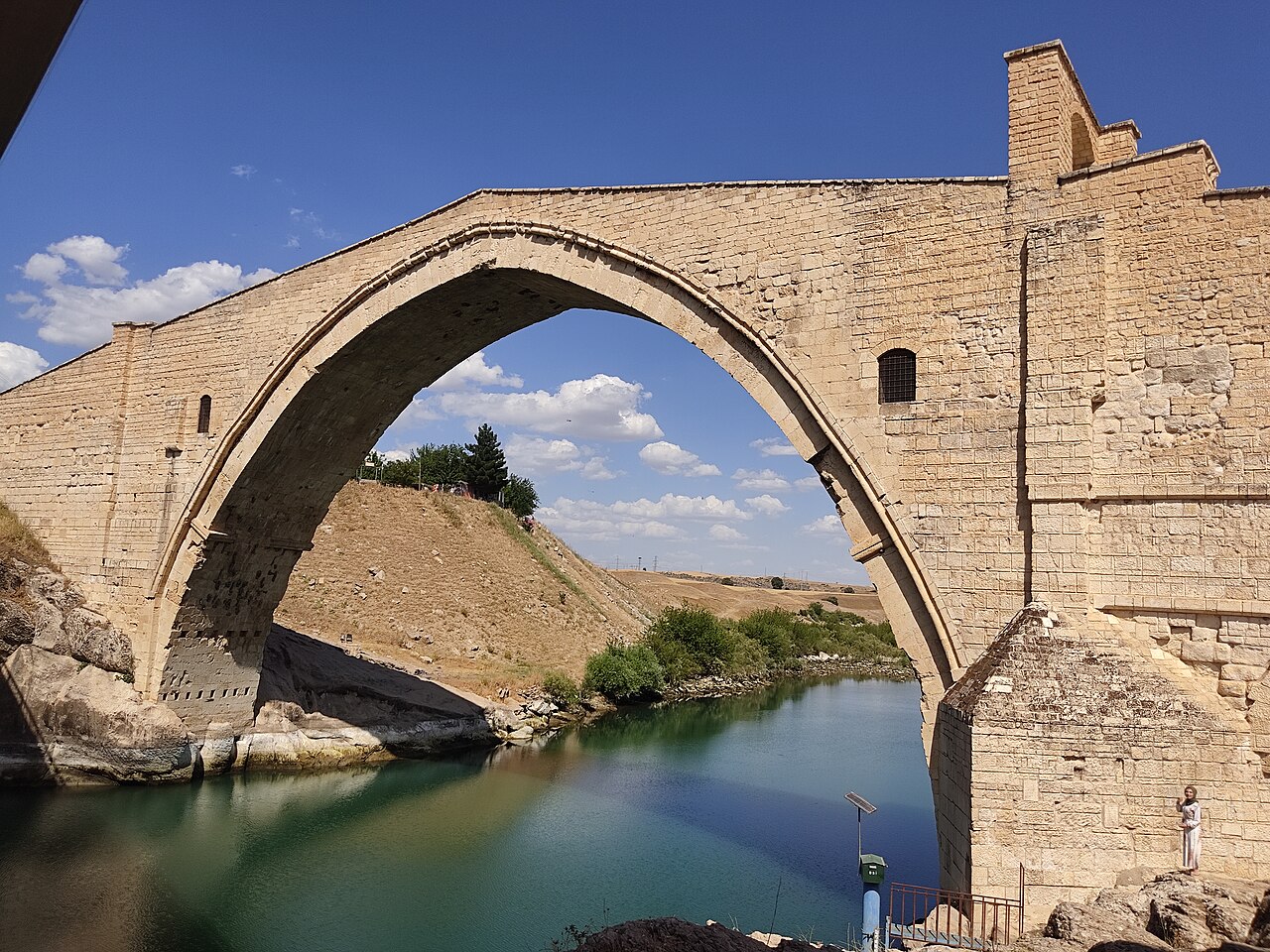
- What: An iconic stone bridge from the Artuqid period, featuring a monumental 38.60-meter pointed arch, a built-in lodging chamber for caravan travelers, an ablution facility, and astrological figural reliefs [1, 2, 3].
- Where: Located between Diyarbakır and Silvan on the historical Silk Road route, spanning the Batman River (Batman Çayı) [1, 2].
- Why significant: Built with an engineering span that could enclose the dome of Hagia Sophia, its 38.60-meter main arch, sheltered guard/lodging rooms inside the piers, and medieval masonry make it the pinnacle of Artuqid hydraulic engineering [1, 2, 3].
The Malabadi Bridge spanning the Batman River between Diyarbakır and Silvan is an important example of Artuqid-period bridge architecture [1, 2]. The Artuqids constructed the largest-span bridges in Anatolia and the Near East [1]. Following the 40.22-meter span of the four-arched Tigris Bridge at Hasankeyf, Malabadi Bridge is the second-largest span [1].
The bridge’s pointed arch spans 38.60 meters [1]. The structure, which remains intact today, is one of the principal works demonstrating the Artuqids’ emphasis on bridge construction for securing trade routes [1, 2].
Historical Context and Construction Process
During their rule in southeastern Anatolia and the region of el-Cezîre (Syria) in the XII–XIII centuries, the Artuqids prioritized infrastructure to sustain commercial and social life, commissioning caravanserais, bridges, mosques, and madrasas [2]. While historical sources confirm that the Artuqids built certain caravanserais, their emphasis on bridge construction for securing trade routes is evident [2].
Artuqid ruler Hüsâmeddin Timurtaş initiated the construction of a 150-meter-long bridge over the Batman River, which was completed during his son Necmeddin Alpı’s reign [2]. Among Hüsâmeddin Timurtaş’s notable works is the Hüsâmiye Madrasa [2]. It is also recorded that Timurtaş established a substantial library with significant book collections [2]. His son Necmeddin Alpı constructed mosques, madrasas, and caravanserais in Koçhisar [2].
Other branches of the Artuqids also engaged in urban development and construction projects [2]. The Artuqid ruler of Hısnıkeyf, Fahreddin Karaaslan, commissioned bridges at Hısnıkeyf, Malatya, Birecik, and Kal’atürrûm to accelerate trade and transportation [2]. Although the Hısnıkeyf Bridge sustained damage from floods and earthquakes in 1166, it was quickly repaired [2].
The four-arched Tigris Bridge at Hasankeyf and the single-span large arch of Malabadi Bridge with its figural reliefs are among the defining bridges of the Artuqid period [1, 2]. The multi-arched Devegeçidi Bridge over the Devegeçidi River north of Diyarbakır also represents another significant bridge from this era [1, 2].
Engineering Solutions and Arch Span
The primary factor determining a bridge’s architectural and engineering significance is the magnitude of its span [1]. The Artuqid master builders constructed the widest arch spans in Anatolia and the Near East, achieving a 38.60-meter pointed barrel vault at Malabadi Bridge [1, 2].
In dry-stone bridge construction, piers were reinforced with flood channels facing the direction of water flow to resist erosion [1]. To ensure uniform compressive stress across the arch, its design was aligned with the pressure line [1]. This large single-span pointed barrel vault measures 38.60 meters and constitutes a significant structural feature [1, 2].
The bridge’s total length reaches 150 meters, providing passage over the Batman River through its wide span [1, 2]. This dry-stone structure, which remains intact today, is the second-largest-span bridge after Hasankeyf Bridge [1].
Social Architecture: Lodging Chamber and Ablution House
Malabadi Bridge is not merely a crossing but also incorporates social infrastructure to meet travelers’ needs for lodging and purification [3].
On this Artuqid-era bridge, there exists a small lodging chamber and an ablution house constructed specifically for travelers requiring overnight accommodation [3]. This practice exemplifies the typical provision of ablution houses as charitable institutions serving both local populations and traveling pilgrims in medieval Islamic civilization [3].
Until the second half of the 20th century, Muslims provided ablution houses solely as charitable gifts without seeking revenue from them [3]. The distribution of ablution houses within mosques, madrasas, and caravanserais introduced this cultural element—previously confined to Byzantine palaces and monasteries—to Anatolian society [3]. The small lodging chamber and ablution house on Malabadi Bridge similarly functioned as a charitable public service addressing the needs of travelers requiring overnight accommodation [3].
Stone Ornamentation and Figural Reliefs
As seen in Artuqid coinage with human figures and falcon-crested arms, the inscribed bands on Diyarbakır’s Ulu Beden and Yedi Kardeş towers also draw attention [2].
A common feature of Artuqid bridges is the inclusion of astrological reliefs on their side walls, often alongside inscriptions [1]. The Malabadi Bridge over the Batman River is a notable example from this period, distinguished by its single-span large arch and figural reliefs [2].
In addition to bridges, mosques and madrasas from the Artuqid era are significant structures reflecting the architectural and stone ornamentation of the period [2].
Restoration History and Preservation Status
Malabadi Bridge remains intact today [1]. The structure has served on the Diyarbakır-Bitlis route since its 12th-century construction, having been restored to reach the present day [1, 2].
The bridge’s 38.60-meter pointed barrel vault, along with its lodging chamber and ablution house for travelers, have survived intact until modern times [1, 3]. As the second-largest-span bridge after Hasankeyf Bridge, Malabadi Bridge is a defining example of Artuqid bridge architecture [1, 2].
Frequently Asked Questions
- In which state period was Malabadi Bridge constructed?
It was built during the Artuqid rule over southeastern Anatolia [1, 2]. Construction began under Hüsâmeddin Timurtaş and was completed during his son Necmeddin Alpı’s reign [2]. - What is the span and length of the bridge?
The pointed barrel vault spans 38.60 meters, making it the second-largest-span bridge after Hasankeyf Bridge in the region [1]. The total length of the bridge is 150 meters [2]. - Over which river does the bridge span?
It crosses the Batman River (Batman Creek) on the Diyarbakır-Bitlis route between Diyarbakır and Silvan [1, 2]. - What facilities are available for travelers on the bridge?
A small lodging chamber and an ablution house were constructed specifically for travelers requiring overnight accommodation [3]. - What is the nature of the stone ornamentation on the bridge?
Artuqid bridges typically feature astrological reliefs on their side walls, often alongside inscriptions [1]; additionally, figural reliefs are present on this bridge [2].
References
- [1] BRIDGE - TDV İslâm Ansiklopedisi (Vol. 26, pp. 252–255), https://islamansiklopedisi.org.tr/kopru
- [2] ARTUQIDS - TDV İslâm Ansiklopedisi (Prof. Dr. Abdülkerim Özaydın, Vol. 3, pp. 415–419), https://islamansiklopedisi.org.tr/artuklular
- [3] ABLUTION HOUSE - TDV İslâm Ansiklopedisi (Prof. Dr. Abdüsselam Uluçam, Vol. 1, pp. 68–69), https://islamansiklopedisi.org.tr/abdesthane
Konum
Harita: © OpenStreetMap katkıcıları. Haritada büyüt · Google Haritalar · Apple Haritalar
İşaret yaklaşık konumu gösterir; kesin konum için yerel kaynaklara bakın.
This article is compiled from scholarly monographs and official architectural inventories. Please verify site access conditions, visiting hours, and ongoing conservation status via official heritage authorities prior to visiting.