


Summary
- What is it? A thematic cultural corridor linking three apex works of 13th–14th century Anatolian Seljuk, Eretna, and Mengücek architecture [1], [2], [3].
- Route: A ~175 km historical route from Sivas Central through the foothills of Çamlıbel and Tecer Mountains to Divriği basin [1], [3].
- Key Structures: Sivas Gökmedrese (Sâhibiye), Güdük Minare (Şeyh Hasan Bey Tomb) and UNESCO World Heritage Divriği Dârüşşifası [1], [2], [3].
- Recommended Duration: 2 days (Day 1: Central Sivas monuments; Day 2: Divriği canyon route and külliye complex) [1], [3].
Historical and Geographical Context
Sivas, situated in the Kızılırmak basin connecting central and eastern Anatolian plateaus, historically functioned as a nexus where northern and southern Silk Road caravans converged [1]. During the 13th century, this city became the second capital of the Seljuk Sultanate of Rum and its largest commercial hub. Despite Mongol pressure following the Battle of Kösedağ (1243), Sivas witnessed an extraordinary building campaign funded by waqf endowments of vizier Sâhib Ata Fahreddin Ali [1], [2]. These monuments, beyond their function as educational or religious structures, represent the Seljuk state’s intellectual and aesthetic resolve etched into stone during the Mongol tempest [1].
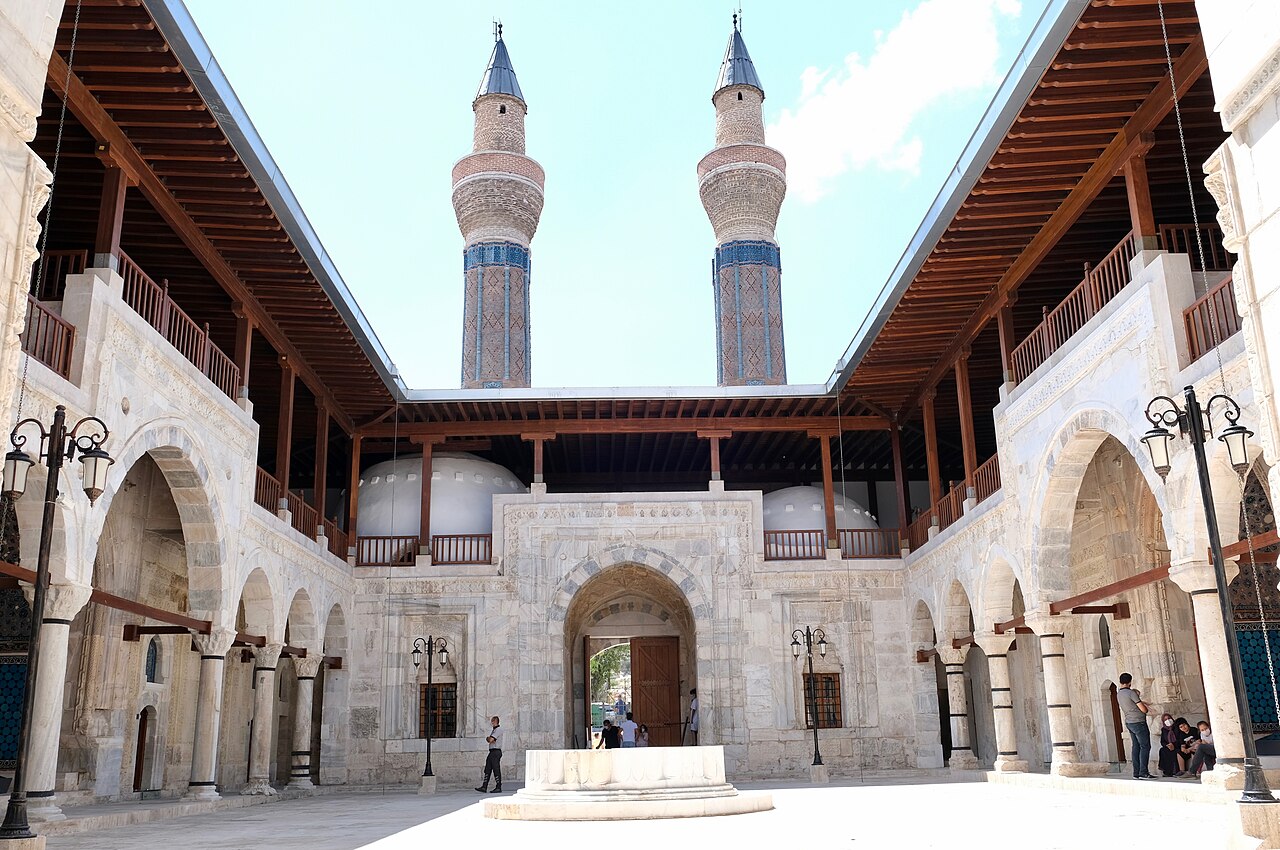
The corridor begins at Sivas’ central monumental core. The first stop is Gökmedrese (1271), whose façade muqarnas corbeling, life tree composition, and lapis lazuli glazed twin minarets epitomize the zenith of Seljuk stone plastic art [1]. Proceeding southward through Sivas’ neighborhoods reveals Güdük Minare (1347), a synthesis of post-Seljuk beylik architecture (Eretnaoğulları). Its square-cut stone base supporting a cylindrical brick body with triangular bingis reflects one of the purest manifestations of Central Asian tower-mausoleum traditions in Anatolia [2].
The corridor’s second phase follows the historical mountain road descending from Sivas plateau to Çaltı Stream valley. This 175 km passage leads to Divriği, capital of the Mengücekoğulları Beylik hidden among mountains [3]. Commissioned by Ahmet Şah and his wife Turan Melek in 1228, Divriği Ulu Camii and Dârüşşifası feature architect Ahlatlı Hürremşah’s unprecedented asymmetrical façades, Baroque stone reliefs, and hospital vaults, marking the corridor’s apex [3].
Architectural Evolution Along the Route
Examining these three stops sequentially reveals a radical stylistic transformation in Anatolian Turkish-Islamic architecture from early 13th to mid-14th century [1], [2], [3]:
1. Ahlat Stonecraft and Mengücek Originality (Divriği, 1228)
Divriği Dârüşşifası transcends Seljuk central artistic conventions with a unique regional boldness [3]. The Western (Götürge) Façade and Şifahane Façade, crafted by Ahlat stone artisans, are adorned with dense botanical curves, geometric patterns, and deep shadows evoking Gothic or Baroque sensibilities [3]. Internally, the courtyard with a water basin, acoustically designed vaults for echoing sounds, and medical acoustics demonstrate that the hospital is not merely stone but embodies a philosophy of medicine integrated with nature and human spirit [3].
2. Sâhib Ata Classicism and Glazed Decoration (Gökmedrese, 1271)
Gökmedrese exemplifies balanced classicism achieved by central Seljuk ateliers under architect Kālûyân el-Konevî [1]. Its two-story, four-iwan open courtyard plan is enriched with twin-headed eagles, life tree, and pomegranate motifs on the marble façade [1]. The transition from brick to glazed tile at minaret bases harmonizes the yellow local stone of the steppe with the blue of the sky through lapis lazuli and turquoise mosaic glazes [1].
3. Beylik Period Tower-Mausoleum Archaism (Güdük Minare, 1347)
Güdük Minare was constructed during the Eretna Beylik period as a tomb for Şeyh Hasan Bey following Seljuk state decline [2]. Here, the expansive iwan and courtyard of madrasas give way to a massive, austere cylindrical brick body [2]. The sub-surface brick courses and black tile mosaic bands demonstrate how art persisted in the steppe even amidst caravan route turbulence [2].
Two-Day Travel Plan and Logistics
A two-day itinerary is recommended for full corridor experience [1], [3]:
-
Day 1 (Sivas Central / 15–20 km):
- Morning: Visit Sâhib Ata’s Gökmedrese. Early morning sunlight enhances the visibility of muqarnas corbeling details and lapis lazuli glazes on the façade [1].
- Afternoon: Proceed to Şeyh Hasan Bey Tomb (Güdük Minare) south of the city center. Examine its square base, brickwork patterns, and Seljuk mausoleum tradition [2].
- Evening: Overnight stay in Sivas city with local cuisine.
-
Day 2 (Divriği Route / 175 km one-way):
- Morning: Depart Sivas toward Divriği by road or morning Raybüs regional train. The journey traverses Tecer Mountains and Çaltı Stream canyon [3].
- Lunch and Afternoon: Spend time at Divriği Ulu Camii and Dârüşşifası. Analyze the monumental Western Façade, acoustic water basin in the hospital, and Mengücek tomb details as afternoon prayer shadows emerge [3].
- Evening: Return to Sivas or overnight stay in Divriği.
Visit Notes
- Transportation: Central Sivas monuments are within walking distance. The Sivas-Divriği route takes ~2h15m by road; morning Raybüs regional trains offer scenic canyon travel alternatives.
- Season: Optimal visit months are May-June and September-October. Winter may bring snow and ice on Divriği passes.
- Access Conditions: Current restoration, prayer, and museum entry rules for monuments should follow official announcements from the Turkish Ministry of Culture and Tourism and General Directorate of Foundations.
References
- [1] “GÖKMEDRESE” — TDV İslâm Ansiklopedisi, Vol. 14 (Prof. Dr. Semavi Eyice) — https://islamansiklopedisi.org.tr/gokmedrese—sivas
- [2] “GÜDÜK MİNARE” — TDV İslâm Ansiklopedisi, Vol. 14 (Prof. Dr. Semavi Eyice) — https://islamansiklopedisi.org.tr/guduk-minare
- [3] “DİVRİĞİ ULU CAMİİ ve DÂRÜŞŞİFASI” — TDV İslâm Ansiklopedisi, Vol. 9 (Prof. Dr. Doğan Kuban) — https://islamansiklopedisi.org.tr/divrigi-ulu-camii-ve-darussifasi
This article is compiled from scholarly monographs and official architectural inventories. Please verify site access conditions, visiting hours, and ongoing conservation status via official heritage authorities prior to visiting.