


Summary
- What is it? A thematic cultural corridor in Eastern Anatolia uniting monumental madrasas and tomb tower architecture from the Saltukid, Seljuk, Ilkhanid, Ahlatshah, and Aq Qoyunlu eras [1], [2], [3], [4], [5].
- Route: A historical route extending from Erzurum across the mountains to Bitlis’s Ahlat district and Lake Van’s Gevaş shore [1], [2], [4], [5].
- Key Structures: Erzurum Çifte Minareli Madrasa, Erzurum Yakutiye Madrasa, Erzurum Üç Kümbetler, Ahlat Ulu Kümbet, Ahlat Emir Bayındır Kümbeti, and Gevaş Halime Hatun Kümbeti [1], [2], [3], [4], [5].
- Recommended Duration: 3 days (Day 1: Erzurum monuments; Day 2: Ahlat historic cemetery and tomb towers; Day 3: Gevaş Halime Hatun Kümbeti and Lake Van).
The Tradition of Madrasa and Tomb Architecture in Eastern Anatolia
A tomb tower (kümbet) is a monumental funerary monument consisting of a cylindrical or polygonal body with an internal dome and an external conical or pyramidal roof (külâh) [5]. Originating as architectural stone translations of Central Asian tent traditions, kümbet towers are typically two-storey structures where the lower subterranean level contains the burial crypt (cenazelik/kripta) [5].
In Eastern Anatolia, these tomb towers often integrate directly with madrasas; while monumental kümbet towers stand independently within cemeteries, large madrasas such as Erzurum Çifte Minareli Madrasa and Yakutiye Madrasa feature prominent mausoleum towers constructed adjacent to their main qibla iwan [1], [2], [5].
Route Stops and Monumental Structures
The corridor’s monumental structures exemplify the region’s architectural heritage [1], [2], [3], [4], [5]:
1. Stop: Erzurum Twin Minaret Madrasa (Hatuniye)
Erzurum Twin Minaret Madrasa features a two-storey, four-iwan plan with an open courtyard [1]. The structure’s most striking feature is its façade; the portal’s deep niche is framed by palmette motifs and covered with muqarnas corbeling [1]. Two brick minarets rise on either side of the portal [1]. A twelve-sided body tomb rises behind the main iwan, crowned with a conical dome [1]. The mummification chamber has a cruciform plan with intersecting vaults, while the upper prayer hall—accessible via two staircases—is covered internally by a dome [1]. The tomb’s cylindrical body is adorned with concentric rounded arches [1].
2. Stop: Erzurum Yakutiye Madrasa
Erzurum Yakutiye Madrasa was constructed in 710 AH (1310–1311) by Cemâleddin Hoca Yâkut Gāzânî during the reign of Olcaytu Hudâbende [2]. This three-iwan, enclosed courtyard madrasa is built from cut stone in a single storey with a rectangular plan [2]. Its façade design draws attention through its portal and symmetrical arrangement [2]. Behind the portal lies an iwan covered by a pointed barrel vault, flanked on either side by chambers [2]. Four thick piers supporting revetted arches bear the central muqarnas-corbelled dome in the rectangular main hall [2]. The façade features a large leaf motif, double-headed eagles, and paired lion-pars figures [2]. A minaret with glazed turquoise and purple bricks rises at the southern corner, while the tomb is located to the east [2]. The tomb’s mummification chamber has a square plan covered by an arched vault [2].
3. Stop: Erzurum Three Tombs
The Erzurum Three Tombs complex includes funerary monuments surrounding Emîr Saltuk Tomb [5]. Among these, the largest is Emîr Saltuk Tomb [5]. The eight-sided structure was built with a two-color cut stone pattern [5]. Relief figures are carved within the arched niches [5]. A conical dome crowns the octagonal body [5].
4. Stop: Ahlat Great Tomb (Usta Şâkird Tomb)
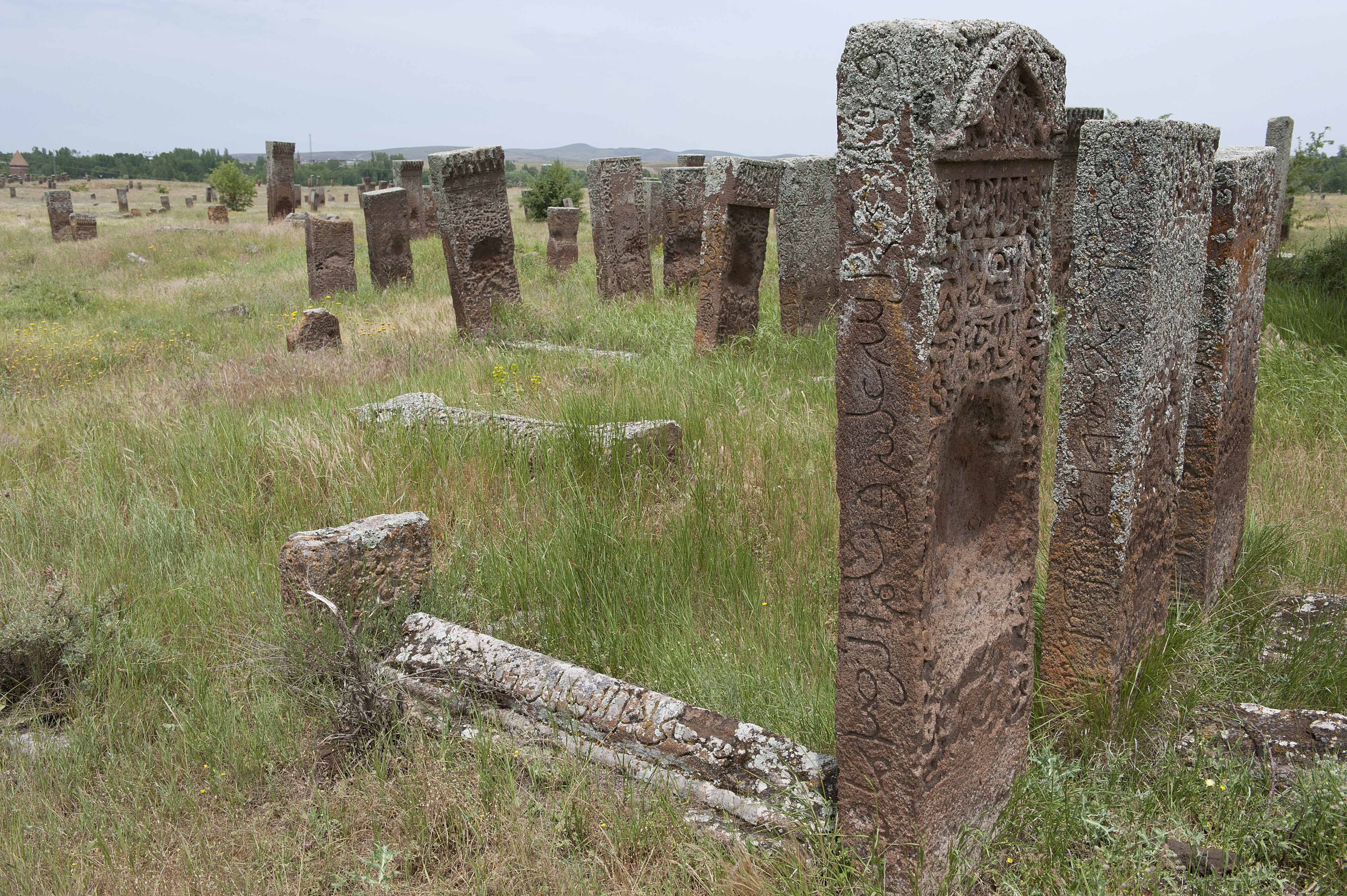
Ahlat’s Great Tomb (Usta Şâkird Tomb) is a cylindrical-body tomb crowned with a conical dome [4], [5]. It represents one of Ahlat’s most significant tomb examples [4]. Together with the Courtyard Cemetery and surrounding monumental tombs, it forms an open-air museum showcasing medieval Turkic funerary typologies [4].
5. Stop: Ahlat Emir Bayındır Tomb
This monument, constructed by Şah Selime Hatun in 1481 following the death of Akkoyunlu Emîr Bayındır b. Rüstem, is distinguished by its columnar architecture [3]. Known colloquially as the “Fingered Tomb” due to its eight short columns, parts of its body are externally framed by arches supported on squat columns [3]. The upper structure is completed with a conical dome [3]. A mosque with a pointed barrel vault stands adjacent to the tomb, entirely constructed from cut stone [3]. The architect is believed to be Baba Can [3].
6. Stop: Gevaş Halime Hatun Tomb
The Halime Hatun Tomb is located in Gevaş [5]. It belongs to the group of octagonal-plan monumental tombs in the region [5].
Three-Day Travel Plan and Logistics
A three-day itinerary can be structured for visiting this route:
-
Day 1 (Erzurum):
- Morning: Visit Erzurum Twin Minaret Madrasa (Hatuniye) and its tomb.
- Afternoon: Explore the portal carvings, muqarnas-corbelled dome, and enclosed courtyard of Yakutiye Madrasa.
- Evening: Study the Erzurum Three Tombs complex.
- Accommodation: Central Erzurum.
-
Day 2 (Erzurum–Ahlat Route):
- Morning: Travel from Erzurum to Ahlat district, Bitlis.
- Afternoon: Visit Ahlat Courtyard Cemetery, Great Tomb, and Emir Bayındır Tomb.
- Accommodation: Ahlat or Tatvan.
-
Day 3 (Ahlat–Gevaş Route):
- Morning: Travel via coastal road to Gevaş.
- Afternoon: Visit Halime Hatun Tomb and its historical cemetery area.
- Evening: Conclude the journey around Lake Van.
Harita
Harita: © OpenStreetMap katkıcıları. Bu yazıda anılan bazı yapılar ve kendi yazıları:
Visit Notes
- Transportation: Airports exist in Erzurum and Van. Inter-city travel is by road.
- Season: Due to high elevation, the optimal visit period is spring and summer months.
- Official Information: Monitor official announcements for visiting hours and restoration projects.
References
- [1] “ÇİFTE MİNARELİ MEDRESE” — TDV İslâm Ansiklopedisi, Vol. 8, pp. 329–331 (Doğan Yavaş) — https://islamansiklopedisi.org.tr/cifte-minareli-medrese—erzurum
- [2] “YÂKUTİYE MEDRESESİ ve KÜMBETİ” — TDV İslâm Ansiklopedisi, Vol. 43, pp. 293–295 (Ayşe Denknalbant) — https://islamansiklopedisi.org.tr/yakutiye-medresesi-ve-kumbeti
- [3] “EMÎR BAYINDIR MESCİDİ ve KÜMBETİ” — TDV İslâm Ansiklopedisi, Vol. 11, p. 125 (Prof. Dr. Ara Altun) — https://islamansiklopedisi.org.tr/emir-bayindir-mescidi-ve-kumbeti
- [4] “AHLAT” — TDV İslâm Ansiklopedisi, Vol. 2, pp. 19–21 (Prof. Dr. Abdüsselâm Uluçam, Faruk Sümer) — https://islamansiklopedisi.org.tr/ahlat
- [5] “KÜMBET” — TDV İslâm Ansiklopedisi, Vol. 26, pp. 562–564 (Doç. Dr. Sema Doğan) — https://islamansiklopedisi.org.tr/kumbet
This article is compiled from scholarly monographs and official architectural inventories. Please verify site access conditions, visiting hours, and ongoing conservation status via official heritage authorities prior to visiting.