
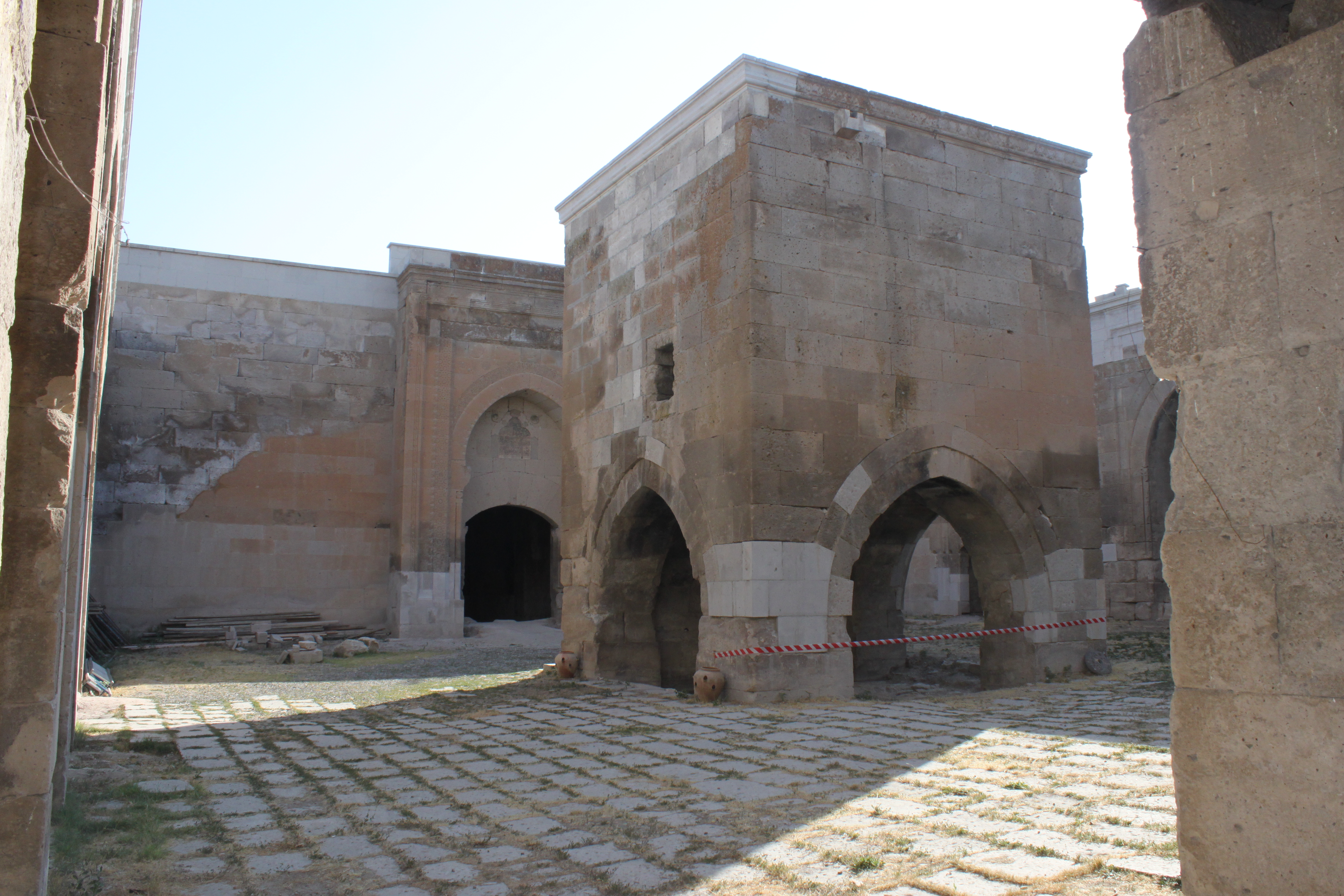
Summary
- What is it? A caravanserai constructed by Hoca Mes‘ûd b. Abdullah on the Aksaray-Kayseri route [1].
- Where is it located? Situated along the Aksaray-Kayseri route [1].
- Why is it significant? With its heavy piers, corner towers, and the gateway positioned along the courtyard’s lateral axis, Ağzıkara Han is the Seljuk caravanserai most resembling a fortress. Notably, all stone ornamentation here is geometric rather than botanical [1].
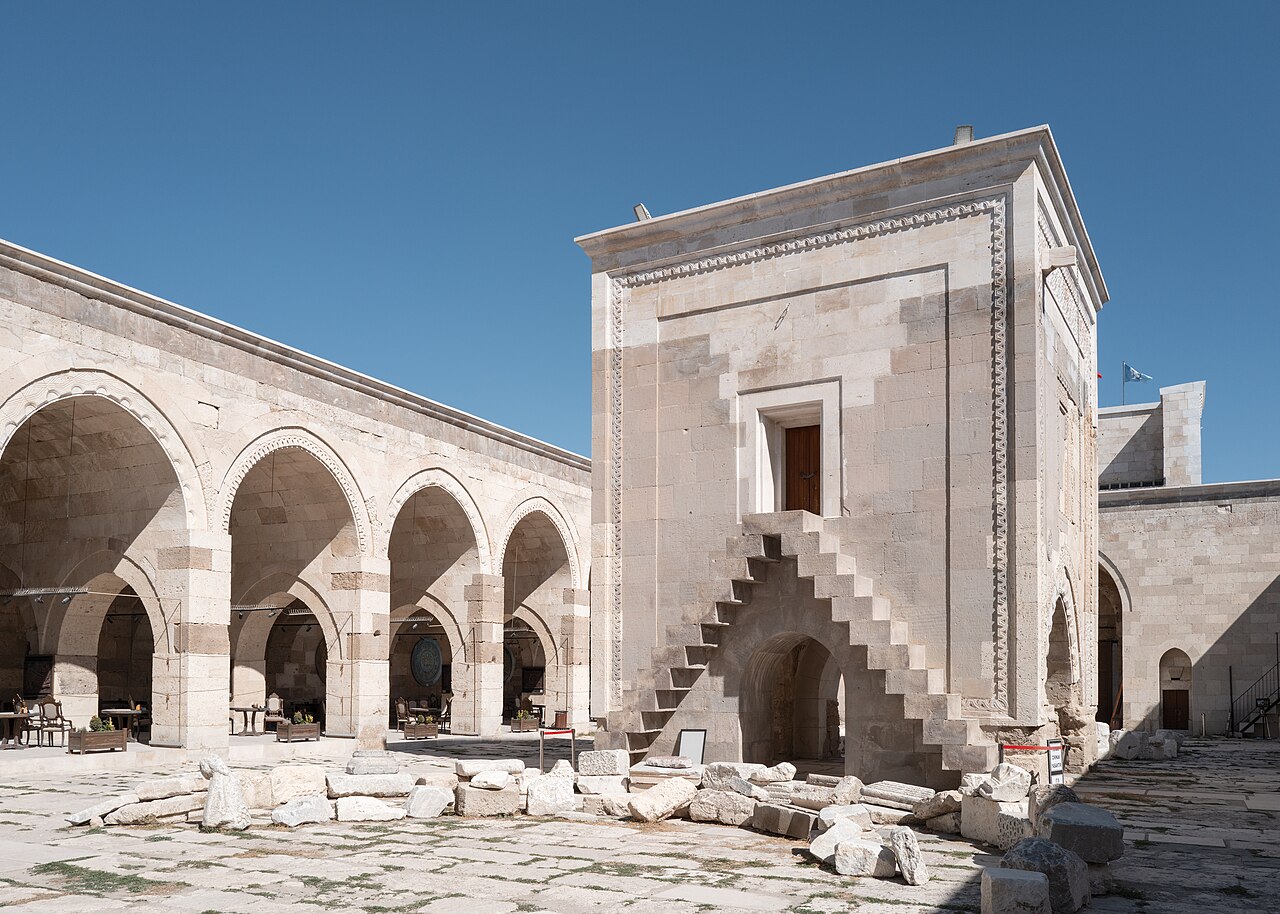
- Architectural Typology: The building’s open courtyard follows a four-iwan schema; centrally located is an elevated cubic kiosk mosque, while the enclosed section features six arched bays with muqarnas corbelled domes [1].
Historical Context and Construction Process
Aksaray, situated on the main route connecting Konya and Kayseri—two cultural centers of the Seljuk period—was effectively rebuilt during the reign of II. Kılıcarslan through religious, commercial, and social structures [2].
According to inscriptions, Ağzıkara Han was constructed in two phases [1]:
- Enclosed Section (Hol): Completed in 628 AH (1231) during the reign of Sultan I. Alâeddin Keykubad [1].
- Open Courtyard: Finalized in 634 AH (1237) during the early years of II. Gıyâseddin Keyhusrev’s rule [1].
The caravanserai was commissioned by Hoca Mes‘ûd b. Abdullah [1]. Its construction began under Alâeddin Keykubad and was completed under II. Gıyâseddin Keyhusrev. Ağzıkara Han (634/1236-37) and Karatay Han (638/1240-41) largely adhere to the classical sultan caravanserai schema, though no kiosk mosque was built at Karatay Han [3].
Architectural Plan and Spatial Composition
The entirely stone-built structure’s open courtyard follows a four-iwan layout [1]:
Open Courtyard Layout
- Side Sections Adjacent to Entrance: These areas are organized as open arcades [1].
- Opposite Wings: The opposite wings form enclosed spaces around the iwan [1].
- Lateral Axis Gateway: The courtyard’s gateway is positioned along its lateral axis [1]. With its heavy piers, corner towers, and laterally aligned gateway, Ağzıkara Han is the Seljuk caravanserai most resembling a fortress [1].
Kiosk Mosque in the Courtyard Center
A kiosk mosque occupies the courtyard’s center [1]:
- Access to this elevated cubic structure is via steps from either side [1].
- Both Aksaray Sultan Han and the Sultan Han on the Kayseri-Sivas route exemplify the classical sultan caravanserai schema, with their courtyards centered on kiosk mosques [3]. Ağzıkara Han continues this tradition [1], [3].
- The mosque’s domes are muqarnas corbelled [1].
Enclosed Section (Hol) and Nave Arrangement
Access to the enclosed section is via an internal gateway from the open courtyard [1]:
- Internal Gateway: This inner gateway, like its external counterpart, features geometric ornamentation [1].
- Structural System and Naves: Six arched bays with domed vaults extend perpendicularly from the central axis, supported by piers connected via arches [1].
- Light Well Dome: A light well dome is positioned along the central axis. Like the kiosk mosque’s domes, this dome is also muqarnas corbelled [1].
Most Seljuk caravanserais consist of an open courtyard with various spaces and a hol section facing it [3]. The hol was designated for travelers and their animals [3].
Stone Ornamentation and Geometric Art
Botanical decoration does not feature in Ağzıkara Han’s stone ornamentation [1]:
- Notably, all stone embellishment here is geometric rather than botanical [1].
- Similarities exist between the gateway ornamentation and design schemes of Aksaray Sultan Han and Karatay Han [1].
Fortress Appearance and Fortifications
Ağzıkara Han is the Seljuk caravanserai most resembling a fortress [1]:
- The structure features heavy piers [1].
- Corner towers are present at each corner [1].
- The courtyard’s gateway is aligned along its lateral axis [1].
- The entire building is constructed of cut stone [1].
Seljuk caravanserais, with their stone-clad walls and reinforced corner towers, resemble fortresses [3]. These structures were designed to ensure both the safety of caravans and to meet all needs of travelers [3].
Position within Seljuk Caravanserai Typology
Most Seljuk caravanserais consist of an open courtyard with various spaces and a hol section facing it [3]:
- Alay Han, completed in 1192 AH (1192) during the final years of II. Kılıcarslan’s reign, is considered the first example of this classical sultan caravanserai schema [3].
- Aksaray Sultan Han (626/1229) and the Sultan Han on the Kayseri-Sivas route (628/1231), both commissioned by Alâeddin Keykubad, fully adhere to this classical schema, with kiosk mosques centered in their courtyards [3].
- Ağzıkara Han (634/1236-37) and Karatay Han (638/1240-41), though largely following the same schema, differ in that no kiosk mosque was built at Karatay Han [3].
- These waqf structures commissioned by sultans and officials granted travelers three days of hospitality without charge [3].
Frequently Asked Questions
When and by whom was Ağzıkara Han constructed?
Ağzıkara Han was commissioned by Hoca Mes‘ûd b. Abdullah; its enclosed section was completed in 628 AH (1231) during the reign of I. Alâeddin Keykubad, while its open courtyard was finalized in 634 AH (1237) under II. Gıyâseddin Keyhusrev [1].
What accounts for Ağzıkara Han’s fortress-like appearance?
With its heavy piers, corner towers, and laterally aligned gateway, it is the Seljuk caravanserai most resembling a fortress [1].
What are the architectural characteristics of the kiosk mosque in the courtyard center?
The elevated cubic kiosk mosque at the courtyard’s center is accessed via steps from either side; its domes are muqarnas corbelled [1].
Which motifs adorn Ağzıkara Han’s stone ornamentation?
Botanical motifs are absent here, with all stone embellishment being geometric in nature [1].
With which caravanserais does Ağzıkara Han’s gateway design resemble?
Similarities exist between the gateway ornamentation and design schemes of Aksaray Sultan Han and Karatay Han [1].
References
- [1] Ara Altun, “Ağzıkara Han”, TDV İslâm Ansiklopedisi, vol. 1, İstanbul 1988, pp. 482–483, https://islamansiklopedisi.org.tr/agzikara-han
- [2] AKSARAY - TDV İslâm Ansiklopedisi, vol. 2, İstanbul 1989, pp. 293–296, https://islamansiklopedisi.org.tr/aksaray
- [3] Semavi Eyice, “Kervansaray - Anadolu Selçuklu Dönemi”, TDV İslâm Ansiklopedisi, vol. 25, Ankara 2002, pp. 299–304, https://islamansiklopedisi.org.tr/kervansaray
Konum
Harita: © OpenStreetMap katkıcıları. Haritada büyüt · Google Haritalar · Apple Haritalar
İşaret yaklaşık konumu gösterir; kesin konum için yerel kaynaklara bakın.
This article is compiled from scholarly monographs and official architectural inventories. Please verify site access conditions, visiting hours, and ongoing conservation status via official heritage authorities prior to visiting.