
Summary
- What is it? A pioneering dual medical and educational complex in Islamic architectural history, uniting a dârüşşifâ (hospice) and medical madrasa within a single structural mass during the Anatolian Seljuk period [1], [2], [3].
- Where is it located? Situated in central Kayseri, now within Mimar Sinan Park [1].
- Architectural Features: A dual-plan structure with two courtyards connected by a narrow passage, four iwans, pointed barrel vaults, patient cells, richly muqarnas corbelled portals, and the founder’s tomb, representing early Seljuk stone architecture [1], [3].
- Founder and History: Commissioned by Sultan I. Gıyâseddin Keyhusrev in 602 (1206) to fulfill his sister Gevher Nesibe Sultan’s will, following her death from smallpox [1], [2].
- Current Status: Restored by the General Directorate of Foundations and now operated as the Seljuk Culture Museum [1].
Historical Context and a Sultan’s Legacy
The Kayseri Gevher Nesibe Complex is not merely an architectural monument but also a material expression of human drama and advanced waqf consciousness [1], [2]. Princess Gevher Nesibe Sultan, daughter of Seljuk Sultan II. Kılıcarslan, fell deeply into despair after her brother Rükneddin Süleyman Şah refused to accept her marriage to the chief chamberlain, leading to the latter’s death in battle [1], [2]. On her deathbed, she willed her wealth to her other brother, Sultan I. Gıyâseddin Keyhusrev, to construct a hospital and medical madrasa for training physicians [1], [2].
Upon ascending the throne for the second time, Sultan I. Gıyâseddin Keyhusrev completed the dârüşşifâ in 602 (1206) [1]. The eastern wing, serving as the medical madrasa (Gıyâsiye), was later finalized during his reign or that of his successor, I. İzzeddin Keykâvus [1], [3].
Medical historians regard this complex as the earliest precursor to modern university hospital and medical school models, with its theoretical medical education in the madrasa physically connected via a corridor to clinical treatment spaces in the dârüşşifâ [1], [3].
Architectural Typology: Twin Madrasa Plan and Spatial Composition
Known colloquially as the “Twin Madrasa,” this monument consists of two rectangular masses aligned east-west [1], [3]. The western wing functions as the dârüşşifâ (hospice), while the eastern wing houses the medical madrasa (Gıyâsiye) [1], [3].
Key spatial elements defining the complex include [1], [3]:
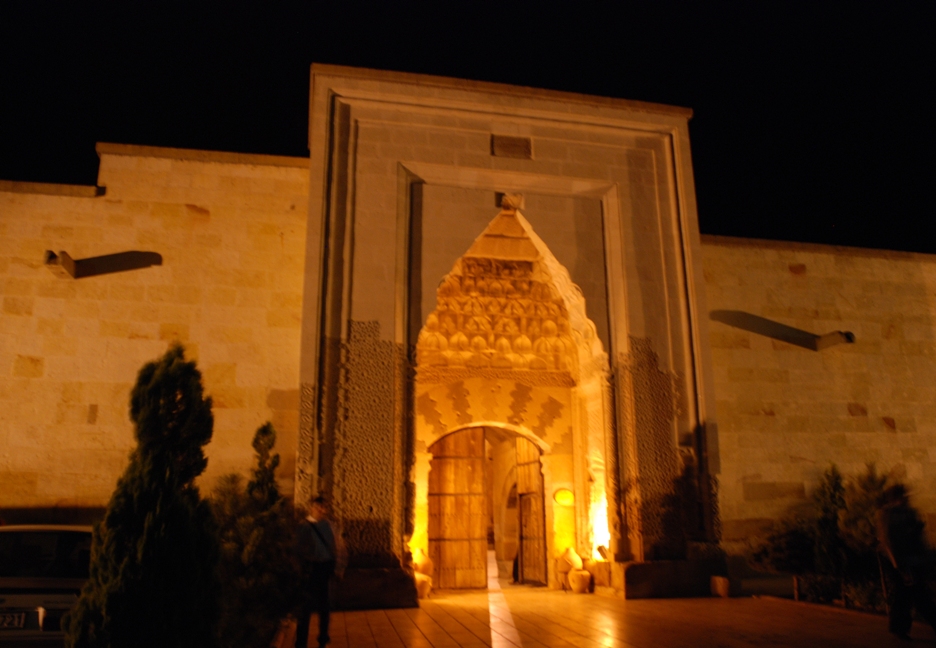
- Dârüşşifâ (Western Wing): Accessible via a monumental portal on the western façade, the dârüşşifâ features a central courtyard with four iwans. The main iwan opposite the entrance served as a treatment and examination hall, while arched rooms flanking the courtyard functioned as patient wards, physician offices, and apothecaries [1].
- Psychiatric Ward Section: Along the northeast corridor of the dârüşşifâ, small vaulted cells are arranged. This section reflects advanced medical understanding of the period, incorporating acoustic treatments, musical therapy, and specialized ventilation channels for psychiatric rehabilitation [1].
- Medical Madrasa (Eastern Wing): Slightly smaller than the dârüşşifâ, this madrasa adheres to a classic plan with an open courtyard and four iwans. Behind the vaulted arcades lie student dormitories and lecture halls. A vaulted passage between the two structures enabled students to transition directly from theoretical classes to clinical practice in the dârüşşifâ [1], [3].
- Gevher Nesibe Sultan Tomb: Adjacent to the western iwan of the dârüşşifâ, a square-plan domed tomb houses the princess’s sarcophagus. This structure serves as the architectural focal point of the complex, symbolizing devotion to its founder [1], [2].
Stone Craftsmanship, Portals, and Decorative Elements
The complex is entirely constructed from ashlar volcanic stone quarried locally in Kayseri [1]. The exterior walls reflect early Seljuk simplicity with massive, fortress-like forms, while mass movement is achieved through buttresses and monumental portals [1], [3].
Two significant portals remain intact [1], [3]:
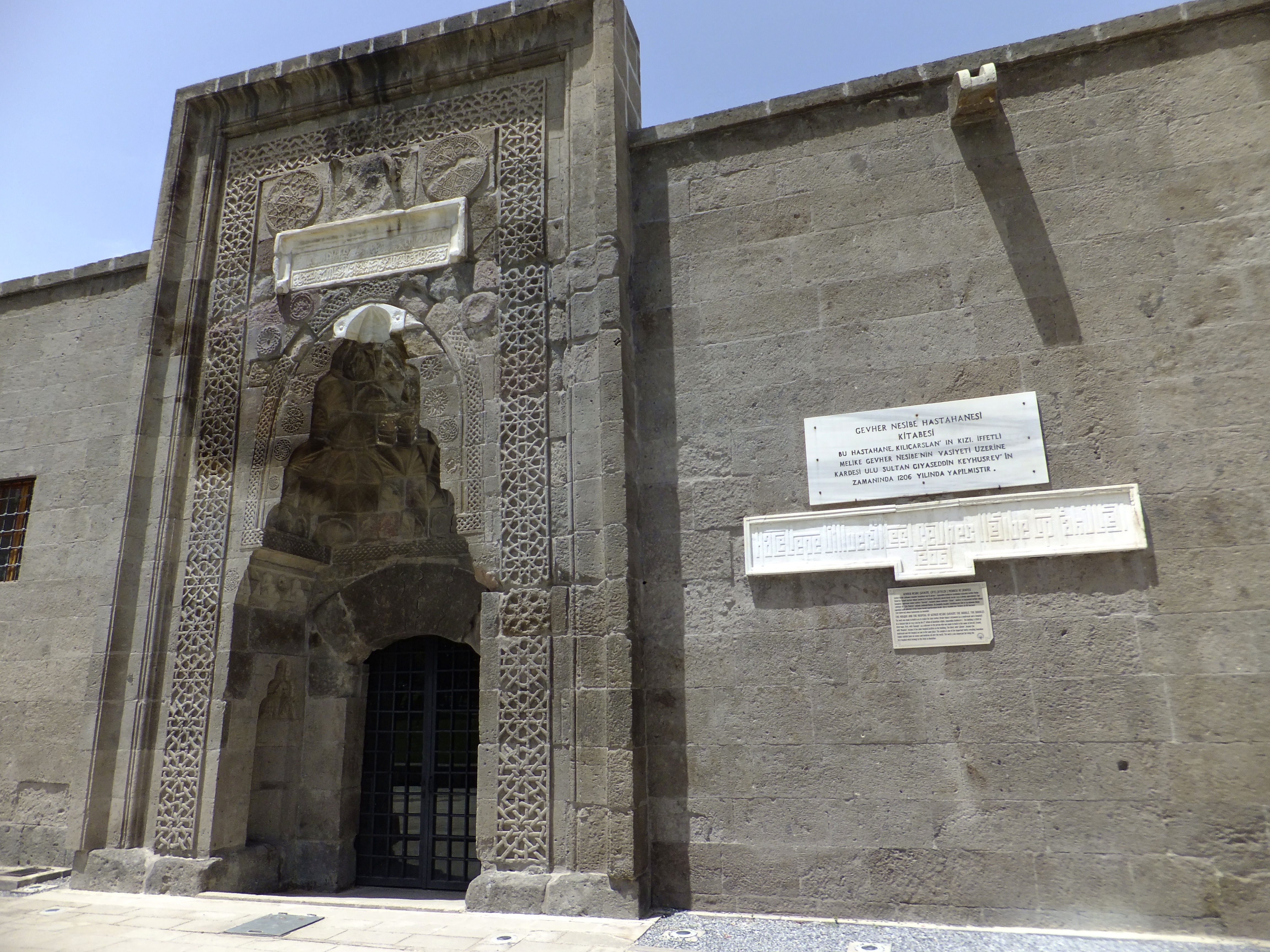
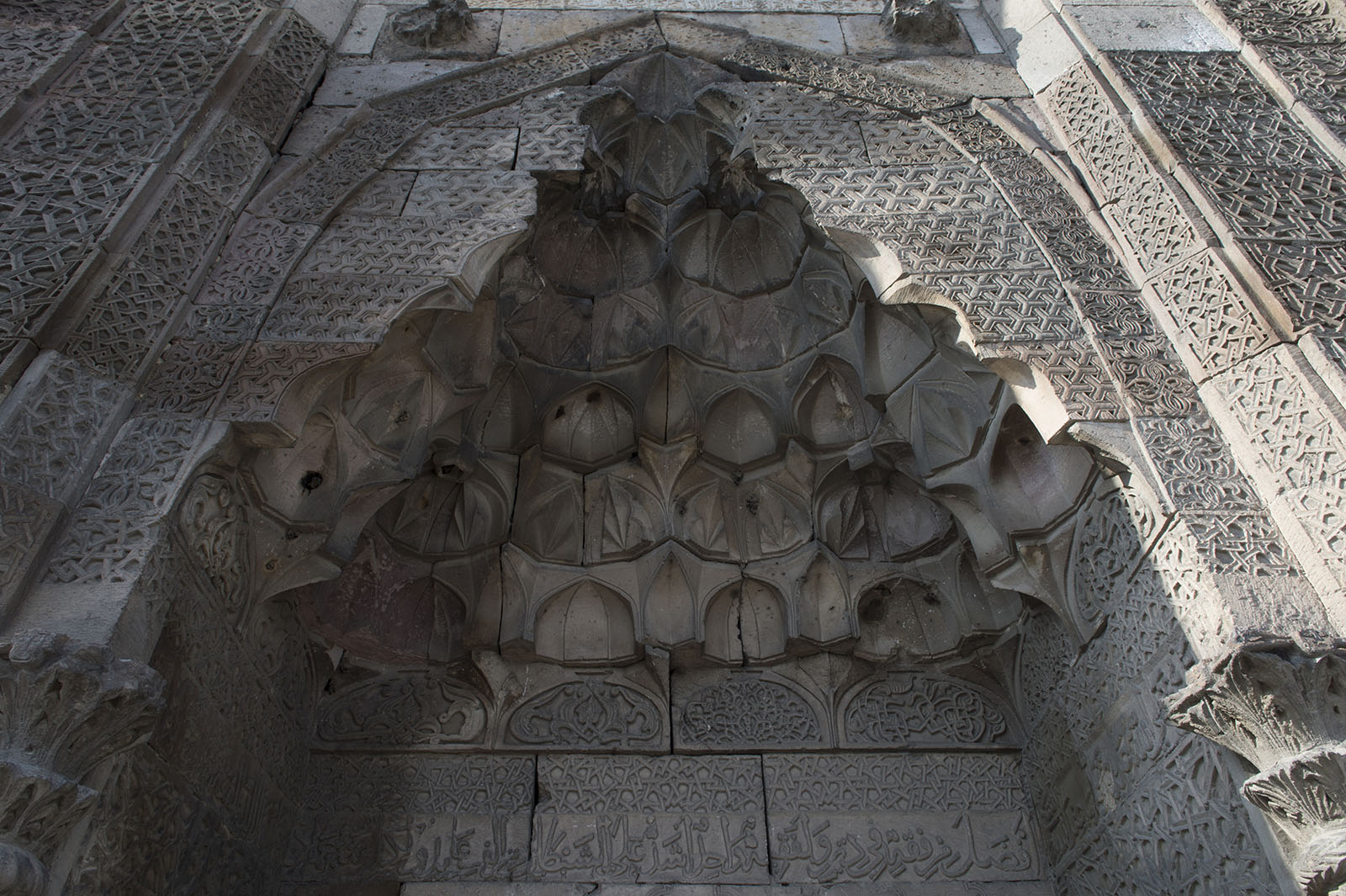
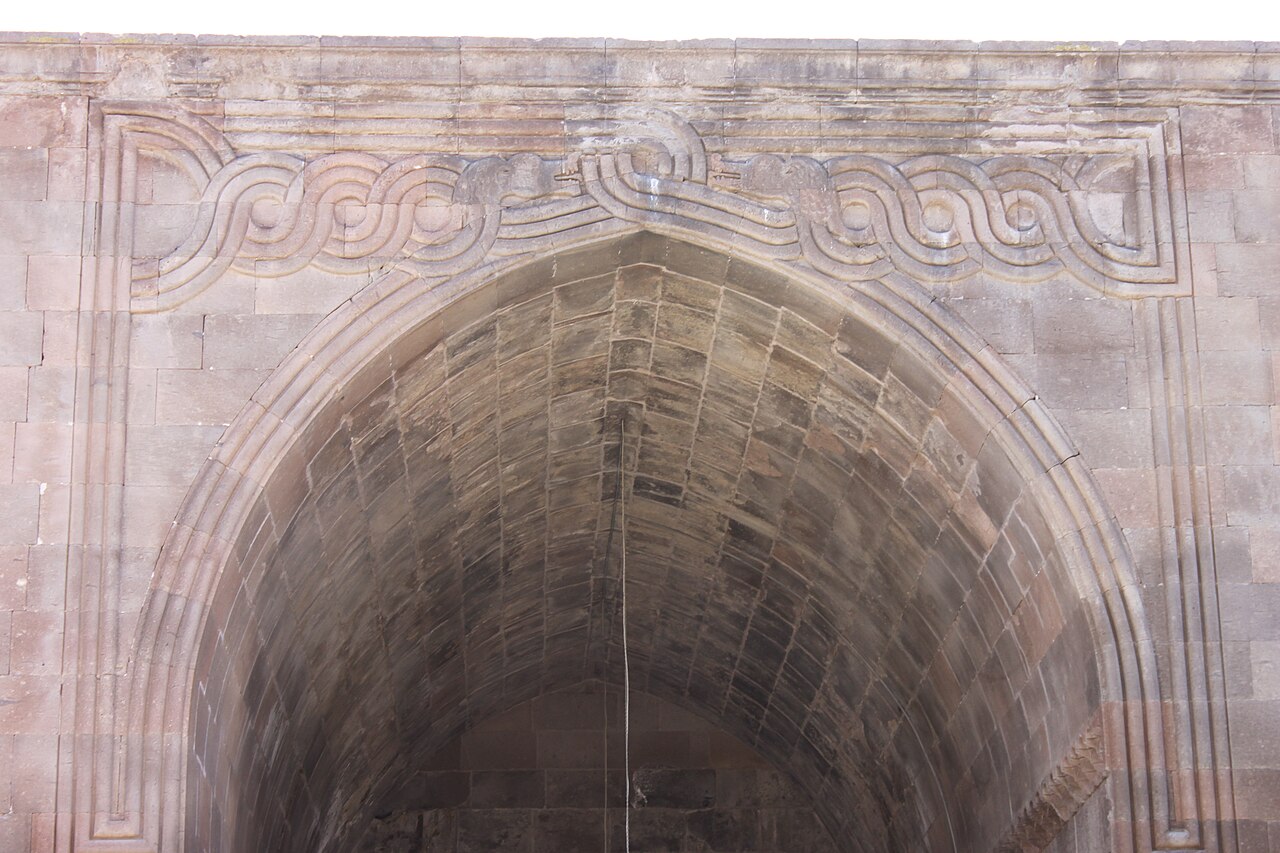
- Dârüşşifâ Portal: Located on the western façade, this portal sits within a deep niche framed by a pointed arch. The niche’s hood is adorned with multi-tiered muqarnas corbeling [1]. Above the entrance lintel lies an epigraphic band in sülüs script, inscribing Sultan I. Gıyâseddin Keyhusrev’s name and noting the completion of the structure in 602 (1206) per Gevher Nesibe Sultan’s will [1], [2]. The portal’s side panels and borders feature stylized geometric patterns and interlaced motifs [1].
- Medical Madrasa Portal: On the southern façade, this portal exhibits a simpler border design compared to the dârüşşifâ entrance. Weathered Seljuk relief fragments resembling lion or bull figures are visible above the muqarnas corbelled hood [1].
Waqf System and Healthcare Services
The Gevher Nesibe Dârüşşifâ represents the pinnacle of Seljuk waqf-based social welfare systems [1], [2]. According to its foundation charter, free healthcare was provided without regard for wealth, religion, or ethnicity, with medications and meals funded by the waqf’s income streams [1].
Medical students training in anatomy, pharmacology, and surgery at the madrasa received clinical instruction under the supervision of senior physicians in the dârüşşifâ [1]. This integration established the complex as a scholarly institution systematically documenting surgical procedures and clinical observations within Turkish-Islamic geography [1].
Restoration History and Living Heritage
Though serving continuously during the Ottoman period, the complex fell into disrepair by the 19th century and was abandoned, eventually becoming ruins [1]. Partial repairs in the mid-20th century gave way to a comprehensive restoration by the General Directorate of Foundations from the 1960s onward [1].
Recent conservation efforts by Erciyes University and the General Directorate of Foundations have reinforced the structure’s vaults, arcades, and courtyards for static stability [1]. Now operated as the Seljuk Culture Museum by Kayseri Metropolitan Municipality, the complex offers visitors an immersive experience through Seljuk medical instruments, healing tablets, apothecary objects, and interactive sound-music installations, preserving an 800-year-old tradition of healing [1].
References
- [1] Semavi Eyice, “Gevher Nesibe Dârüşşifâsı ve Tıp Medresesi”, TDV İslâm Ansiklopedisi, vol. 14, pp. 44-47, 1996. https://islamansiklopedisi.org.tr/gevher-nesibe-darussifasi-ve-tib-medresesi
- [2] Erdoğan Merçil, “Gevher Nesibe Sultan”, TDV İslâm Ansiklopedisi, vol. 14, p. 44, 1996. https://islamansiklopedisi.org.tr/gevher-nesibe-sultan
- [3] Semavi Eyice, “Çifte Medrese”, TDV İslâm Ansiklopedisi, vol. 8, pp. 317-318, 1993. https://islamansiklopedisi.org.tr/cifte-medrese
Konum
Harita: © OpenStreetMap katkıcıları. Haritada büyüt · Google Haritalar · Apple Haritalar
İşaret yaklaşık konumu gösterir; kesin konum için yerel kaynaklara bakın.
This article is compiled from scholarly monographs and official architectural inventories. Please verify site access conditions, visiting hours, and ongoing conservation status via official heritage authorities prior to visiting.
_DSCF0761.jpg)