
Summary
- What is it? A historical royal necropolis and memorial complex comprising the tomb of Emir Izzeddin Saltuk, recognized as one of Anatolia’s earliest Turkic funerary monuments, along with twelve anonymous tombs dated between the 12th and 14th centuries [1], [2].
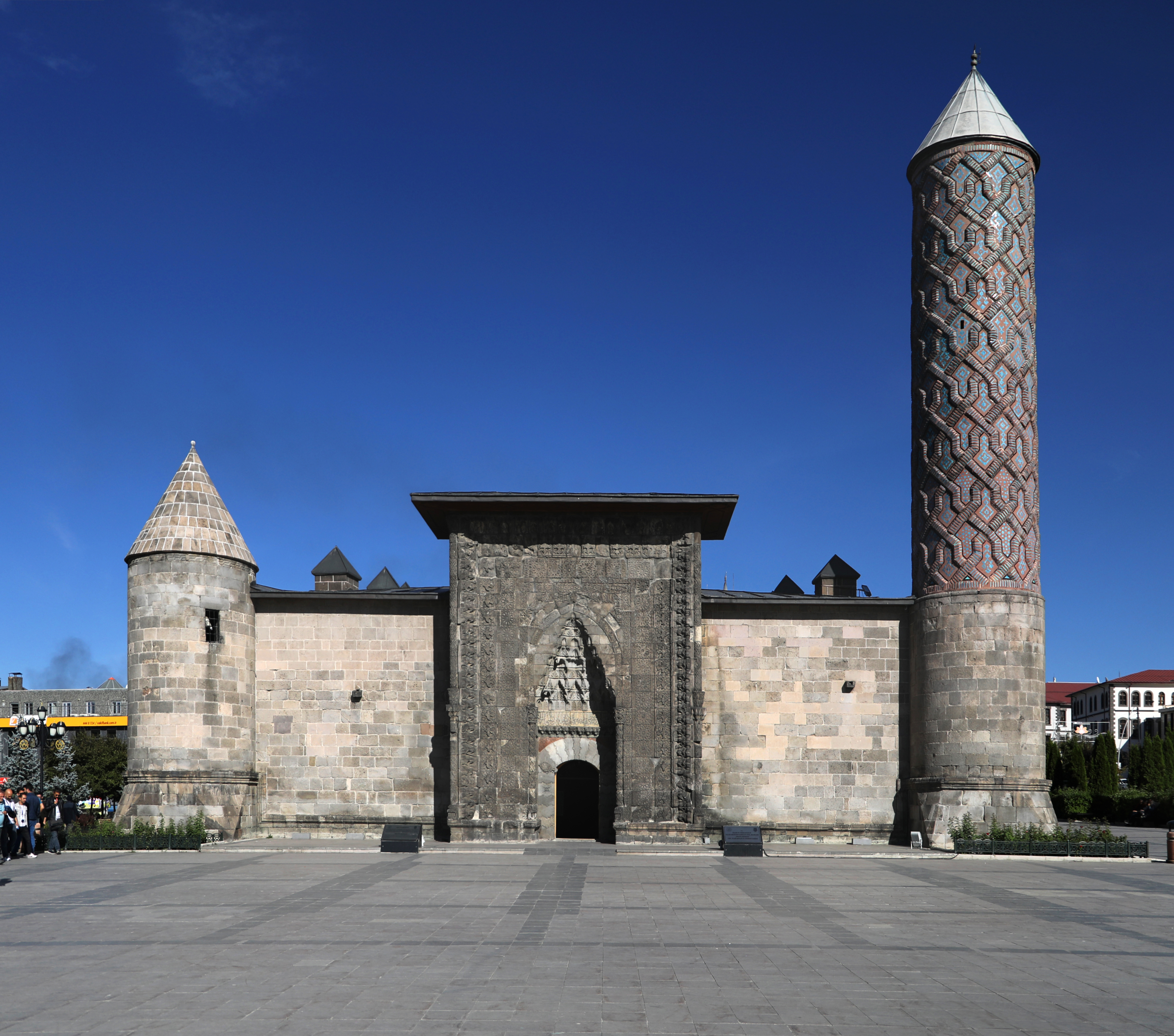
- Where is it? Located in central Yakutiye district of Erzurum, within a historic open space south of the Double Minaret Madrasa and Erzurum Fortress [1], [3].
- Why is it important? The tomb of Emir Saltuk stands as a unique early-period monument inscribing pre-Islamic Turkic cosmology and the Twelve Animal Calendar onto stone through its two-colored ashlar masonry, octagonal body with triangular arches, and sculpted reliefs of twin serpents, griffins, bulls, and human heads on its cylindrical drum [1], [2].
- Architectural Typology: A subterranean rectangular crypt (mummery) with a vaulted ceiling, an upper octagonal and dodecagonal domed prayer space; externally, a combination of dome and conical roof covering the tomb cluster [1], [3].
Historical Context and Construction Process
Following the 1071 Battle of Malazgirt, the Saltuks (1072–1202), the first Turkic principality established in Eastern Anatolia, urbanized Erzurum, constructing its earliest monumental mosques, fortresses, and tombs [1], [2]. The Three Tombs area, situated just outside the city’s southern fortress walls, functioned as a sacred necropolis for generations, serving as the eternal resting place of Saltuk dynasty members and subsequent Ilkhanid administrators [1], [3].
The most prominent and earliest structure within the complex, the Tomb of Emir Saltuk, lacks an inscribed construction date [1]. However, art historians and epigraphic specialists concur through analysis of its architectural proportions and archaic features that it was built during the reign of Emir Izzeddin Saltuk in the mid-12th century [1], [2]. Cultural and Tourism Ministry sources and the TDV İslâm Ansiklopedisi emphasize its status as one of Anatolia’s earliest surviving Turkic tombs [1], [2].
Though popularly known as “Three Tombs,” the site contains four funerary structures [1], [3]:
- Tomb of Emir Saltuk: Mid-12th century, Saltuk period.
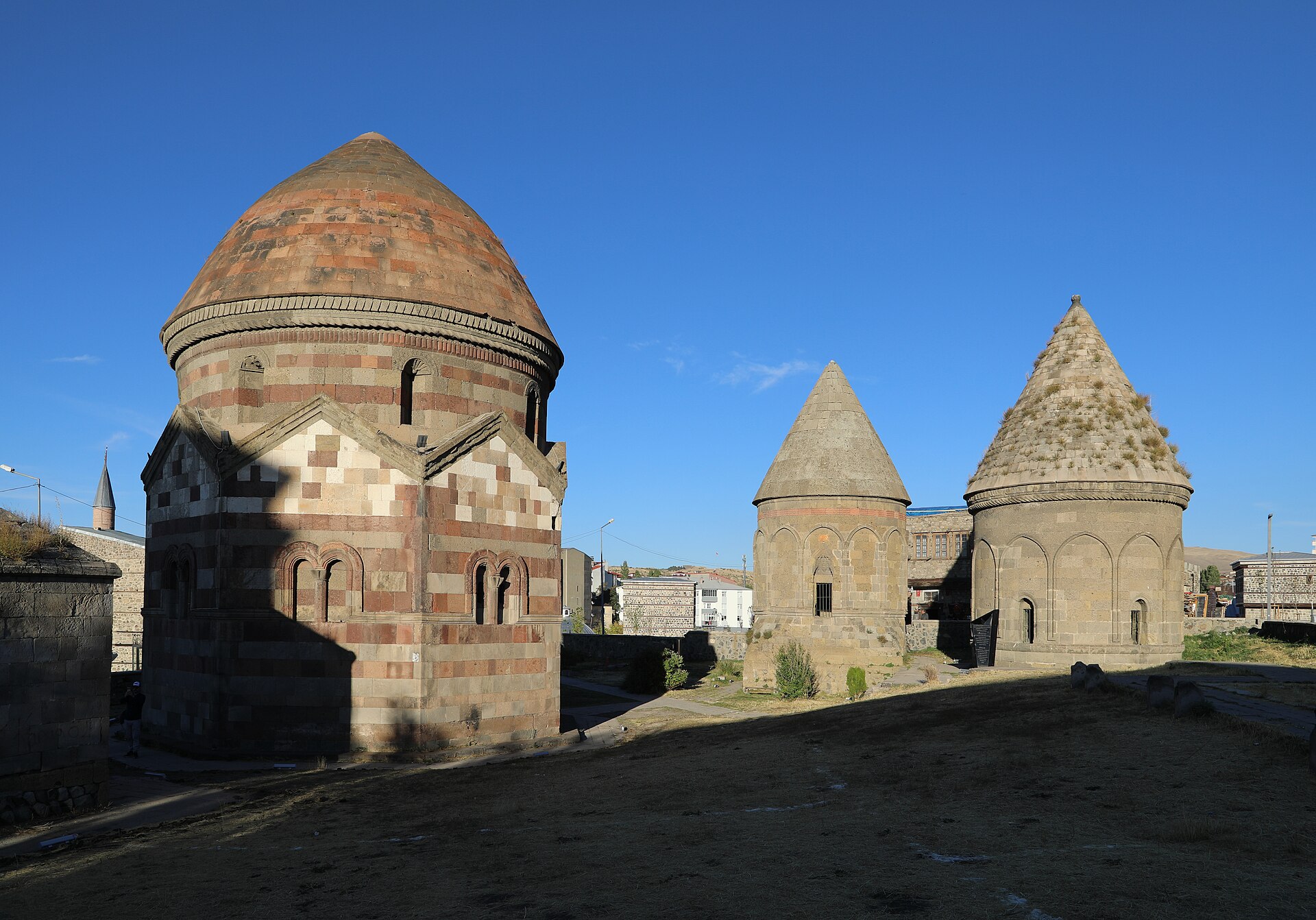
- Anonymous Tomb I (Southeast): Dodecagonal body with chain-bordeled frieze; early 14th century Ilkhanid period [1].
- Anonymous Tomb II (Southwest): Dodecagonal body with rope-motif frieze; 14th century [1].
- Fourth Structure (West): Square-plan, small mausoleum with sloping stone roof; late 13th or early 14th century [1], [3].
The expansive necropolis was largely destroyed by 20th-century wars and urban transformations, leaving only these four monumental tombs intact [1], [2].
Architectural Plan and Spatial Composition
The Tomb of Emir Saltuk occupies a unique position in Anatolian tomb architecture through its plan schema and volumetric plasticity [1], [2]. The structure employs a classical two-tiered composition: a subterranean crypt (mummery) and an upper prayer chamber [1].
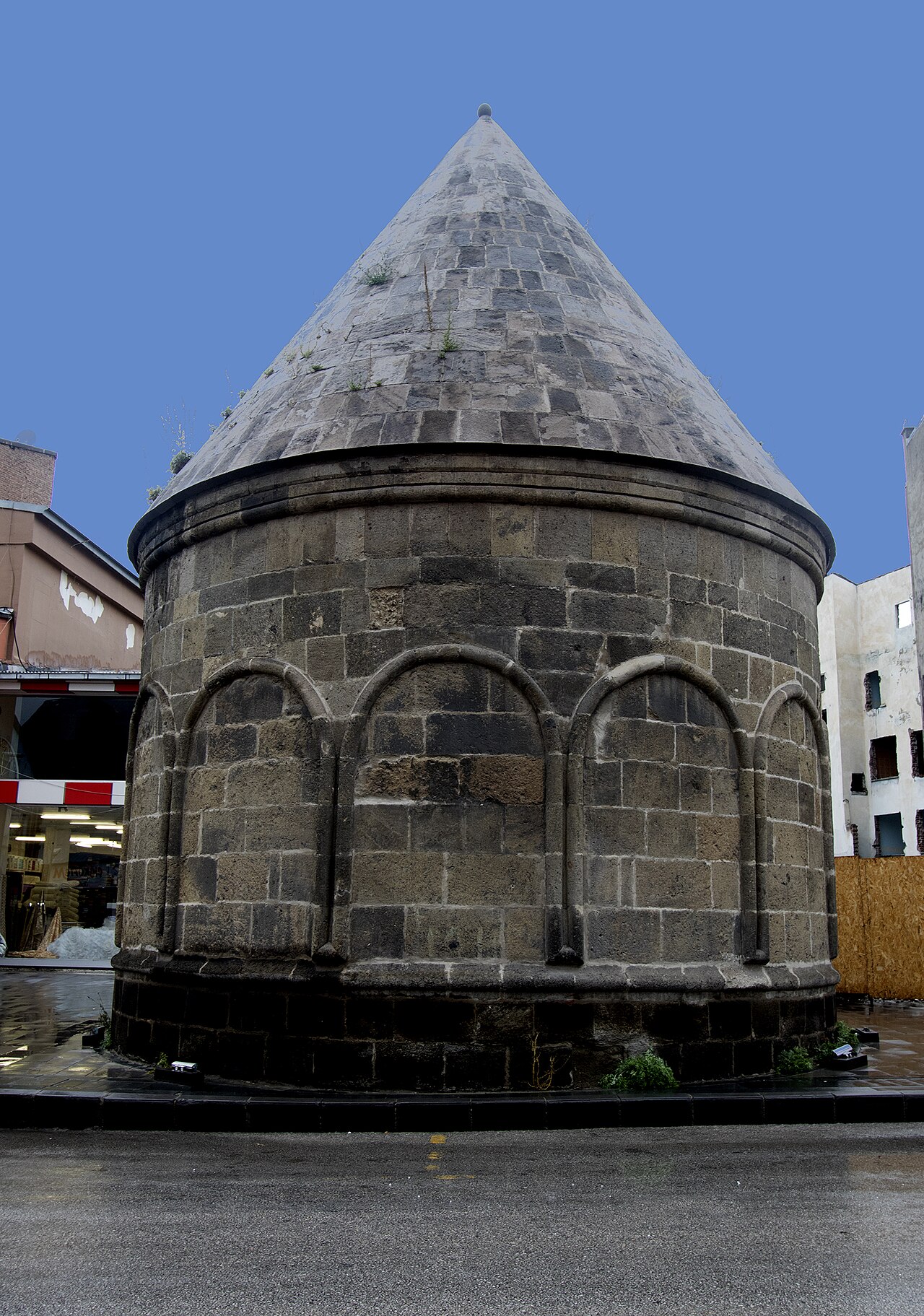
The tomb’s body is octagonal in form [1]. A striking two-color (almaşık) façade was achieved through alternating bands of the region’s volcanic red tuff stone with dark-colored basalt and andesite stones [1], [2]. Each face terminates in three-tiered flat stone courses forming triangular arches [1].
Above the octagonal body rises a high cylindrical drum, beginning approximately 0.5 meters inward from the sides [1], [2]. This drum is adorned with segmented lower bands, rope-motif middle bands, and leaf-shaped upper cornices [1]. The external roof ascends in conical form while transitioning to an exceptionally original stone dome at its apex [1], [2].
The interior space is circular, with muqarnas corbeling trompes forming a shell-like transition from the octagonal body to the central dome [1]. The subterranean burial chamber (crypt) is rectangular and vaulted, housing a symbolic stone casket [1], [2].
Anonymous Tomb I in the southeast exhibits classic 14th-century proportions with its square base, dodecagonal body, cylindrical drum, and conical stone roof [1]. Anonymous Tomb II in the southwest continues Seljuk stone traditions through its dodecagonal body and rope-motif frieze [1], [3].
Stone Decoration, Ornamentation, and Inscriptions
The Tomb of Emir Saltuk contains some of the most enigmatic and iconographically rich figural stone reliefs in Turkic art history [1], [2].
Each face of the octagonal body features paired round-arched windows separated by polygonal pilasters [1]. The north, east, west, and south-facing windows open as light shafts into the interior space, while the remaining four sides are designed as blind niches embedded in the walls [1], [2]. Two-tiered flat stone courses encircling the body create a continuous horizontal rhythm across the façade [1]. The north portal’s round arch contains geometric star motifs and knot patterns on its lintel [1].
The tomb’s artistic significance lies primarily in the eight sculpted reliefs within the cylindrical drum’s triangular niches [1], [2]. These figures, arranged sequentially from the right of the northern portal, include:
- Twin Serpents: Two interwoven serpentine forms with opposing heads [1].
- Winged Figure: A bat or mythological bird in flight with outstretched wings [1].
- Griffin: A majestic griffin with wings spread wide, symbolizing power and dominion [1].
- Hare: A long-eared hare rendered in steppe animal style [1].
- Bull and Human Head: A powerful bull head with a human face centered on its horns [1].
- & 7. Botanical Motifs: Rumi and palmette scrolls symbolizing life’s sprouting [1].
- Mythological Being: A sphinx-like guardian figure with griffin head and human body [1].
Professor Dr. Haldun Özkan and other researchers assert that this rich iconographic ensemble directly reflects pre-Islamic Central Asian Turkic cosmology, the Twelve Animal Calendar, celestial bodies, and shamanistic worldviews [1], [2].
Waqf System and Social Function
The Three Tombs constitute a vast waqf necropolis established by the Saltuk state in its capital to provide prayer for the souls of royal family members, scholars, and veterans [1], [3]. The upper prayer chamber of Emir Saltuk’s tomb functioned as an operational mosque where the tomb custodian and visitors performed daily prayers and recited hatims [1], [2].
According to waqf regulations, a portion of agricultural revenues from Erzurum Plain villages and shop rents within the city were allocated for the maintenance, illumination, and salaries of personnel responsible for these monuments [2], [3]. Its spatial proximity to the Double Minaret Madrasa and Ulu Mosque transformed the Three Tombs into the holiest nexus of knowledge, worship, and eternal life in Erzurum [1], [3].
Restoration History and Preservation Status
Despite exposure to harsh winter conditions, severe frosts, and earthquakes characteristic of Erzurum’s continental climate, the tombs have remained standing due to the solidity of their stonework [1], [2]. However, surrounding tomb walls were gradually destroyed over centuries, leaving the area buried under debris [1].
Registered as a protected complex by the Gayrimenkul Eski Eserler ve Anıtlar Yüksek Kurulu (GEEAK) during the Republic era, the site underwent restoration in the 1950s, 1980s, and 2010s by the General Directorate of Foundations [1], [3]. Between 2018–2021, under a collaboration between Erzurum Metropolitan Municipality and the General Directorate of Foundations, the “Three Tombs Attraction Center and Plaza Development Project” cleared non-historic structures around the site, transforming it into a modern archaeopark with walking paths, open-air exhibition spaces, and lighting systems [1], [3]. The monuments are currently accessible as an open-air museum [1], [2].
Frequently Asked Questions
How many tombs are actually present on the site?
Despite its popular name “Three Tombs,” the historic area contains four funerary structures: the Tomb of Emir Saltuk, two anonymous dodecagonal tombs, and a small square-plan mausoleum [1], [3].
When was the Tomb of Emir Saltuk constructed?
Although lacking an inscribed date, its architectural features and stonework suggest construction during the reign of Emir Izzeddin Saltuk in the mid-12th century [1], [2].
What do the animal reliefs on the drum symbolize?
The sculpted twin serpents, griffins, bulls, hares, and human heads on the drum directly relate to pre-Islamic Central Asian Turkic cosmology, guardian spirits, and the Twelve Animal Calendar [1], [2].
What does the two-colored stone façade signify?
This almaşık technique, achieved through alternating bands of red tuff and dark basalt stones, represents one of the most characteristic visual signatures of early Saltuk architecture [1], [2].
References
- [1] Haldun Özkan, “Three Tombs,” TDV İslâm Ansiklopedisi, Vol. 42, pp. 276–277, İstanbul 2012 — https://islamansiklopedisi.org.tr/uc-kumbetler
- [2] Abdürrahim Şerif Beygu, “Erzurum: History, Monuments, Inscriptions,” pp. 86–91, İstanbul 1936 — https://kulturportali.gov.tr
- [3] İbrahim Hakkı Konyalı, “History of Erzurum with Its Monuments and Inscriptions,” pp. 418–422, İstanbul 1960 — https://erzurum.bel.tr
Konum
Harita: © OpenStreetMap katkıcıları. Haritada büyüt · Google Haritalar · Apple Haritalar
İşaret yaklaşık konumu gösterir; kesin konum için yerel kaynaklara bakın.
This article is compiled from scholarly monographs and official architectural inventories. Please verify site access conditions, visiting hours, and ongoing conservation status via official heritage authorities prior to visiting.
_04.jpg)